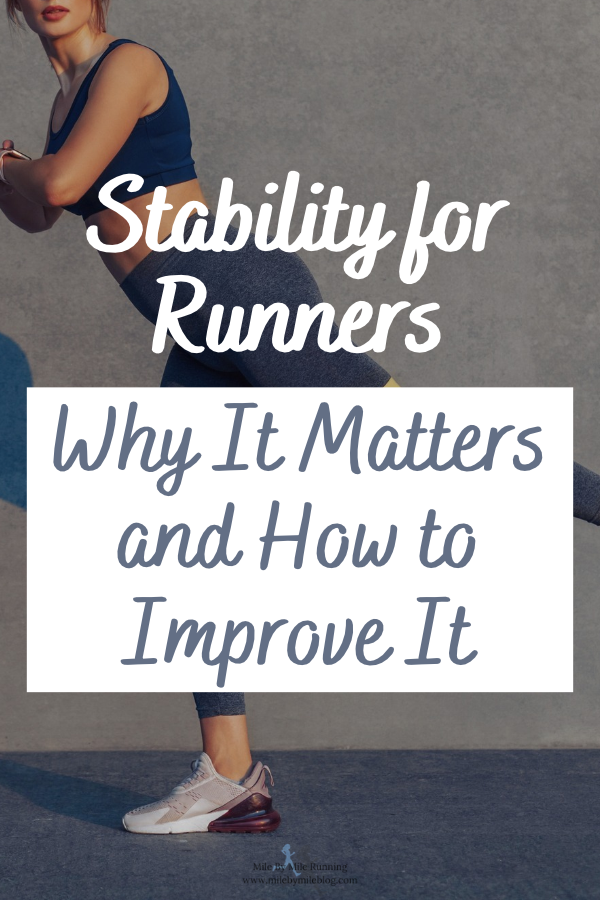
One important component of training that is sometimes overlooked is stability. Stability helps runners maintain balance, control their movements, and manage the demands of the repetitive single leg landing that happens with each stride we take. It also works alongside strength and mobility to support efficient running mechanics.
Incorporating stability exercises into your routine can help you become a stronger, more well-rounded runner. Understanding why stability matters and how to improve it can help you get more out of your training and build a solid foundation.
What Is Stability in Running?
Stability in running is the ability to control your body’s movements and maintain proper alignment as you run. It involves the muscles, joints, and nervous system working together to keep your body balanced and controlled with each stride. Because running requires you to repeatedly land on one foot at a time, stability helps you control your movement as you transition from one leg to the other.
Why Is Stability Important for Runners?
Stability relies on several areas of the body, including the core, hips, glutes, ankles, and feet. These muscles work together to help control your pelvis, keep your legs aligned, and manage the forces your body experiences when your foot strikes the ground. Good stability can help you maintain consistent running mechanics, especially when navigating uneven terrain or becoming fatigued.
Stability is related to strength, balance, and mobility, but each plays a different role. Strength allows your muscles to produce force, balance helps you maintain your center of gravity, and mobility allows your joints to move through an appropriate range of motion. Stability brings these abilities together to help you control your movements while running.
Which Muscles Help Runners Maintain Stability?
Stability depends on coordinated movement throughout the core, hips, legs, and feet.
The core muscles, including the abdominals, obliques, and deep stabilizing muscles around the spine, help control the movement of the trunk and pelvis while running. A strong, well-coordinated core helps limit excessive rotation and side-to-side movement, allowing runners to maintain control and efficient running mechanics.
The gluteus medius and gluteus maximus play an important role in running stability. The gluteus medius helps control the pelvis when standing on one leg, while the gluteus maximus helps extend the hip and contributes to controlling the leg and pelvis during the running stride. Other hip muscles also help control rotation and alignment.
The quadriceps and hamstrings help stabilize the knee and control movement as the leg absorbs and produces force during running. The quadriceps help control knee bending when landing, while the hamstrings contribute to hip extension, knee control, and deceleration of the lower leg as it swings forward.
The calf muscles help control the ankle and support the body as the foot contacts the ground and pushes off. They contribute to managing landing forces and producing forward propulsion. The smaller muscles of the feet and the muscles surrounding the ankle help control foot movement, support the arches, and adapt to changes in the running surface.
Signs You May Need to Improve Your Running Stability
Difficulty Balancing on One Leg
Running requires you to repeatedly support your body on one leg at a time. If you struggle to maintain a single-leg balance without wobbling, shifting your foot, or reaching for support, you may benefit from exercises that improve balance and movement control.
Your Hips Drop or Shift Side to Side
If your pelvis drops on one side or shifts excessively as you run, it may indicate difficulty controlling your hips during single leg support. The gluteal muscles and other hip stabilizers help control pelvic movement with each stride.
Your Knees Move Inward During Movement
If your knees consistently move inward during exercises such as squats, lunges, or step-downs, you may have difficulty controlling lower-body alignment. (This may involve strength or individual movement patterns, rather than stability alone.)
You Feel Wobbly on Uneven Terrain
Running on trails, grass, or uneven surfaces requires your feet, ankles, and legs to continually adjust to changes in the ground. If you frequently struggle to control your footing, balance exercises and progressive strength training may help you feel better on varied terrain.
Your Running Form Deteriorates When You Get Tired
You may notice more side to side movement, reduced control of your posture, or difficulty maintaining consistent mechanics toward the end of a long run. Fatigue can affect coordination and muscle function, so building strength and stability may help you maintain control as training demands increase.
You Struggle With Single-Leg Strength Exercises
Exercises such as single-leg deadlifts, step-downs, and single-leg squats challenge your ability to control your body while supporting yourself on one leg. If you find these movements difficult because of wobbling or loss of control, they may be useful exercises to practice with appropriate support and reduced difficulty.
You Have Recurring Running Injuries or Discomfort
Recurring pain in the hips, back, knees, ankles, or feet may prompt you to evaluate your overall training routine, which includes strength, stability, recovery, and training load. Stability may be one area to look at but is usually one part of a bigger rehab plan.
Stability Exercises for Runners
Here are some examples of stability exercises. The goal is to focus on control, balance and coordination versus doing a very high number or reps or using heavy weights. These work well as part of a running warm up or as part of a strength workout.
Side Plank
Targets: Core, obliques, hip stabilizers
Lie on your side with your elbow beneath your shoulder. Lift your hips until your body forms a straight line, keeping your hips stacked and your trunk steady.
Reps: 2–3 sets of 15–30 seconds per side.
Make it easier: Keep your knees bent and supported on the floor.
Single-Leg Romanian Deadlift
Targets: Glutes, hamstrings, hips, core
Stand on one leg and hinge forward at the hips as your free leg extends behind you. Keep your back neutral and your pelvis facing the floor, then return to standing without losing balance.
Reps: 2–3 sets of 6–10 repetitions per leg.
Make it easier: Use a wall or chair for support.
Bird Dog
Targets: Core, spinal stabilizers, glutes
Start on your hands and knees. Extend one arm and the opposite leg while keeping your back flat and your hips level. Pause briefly, return to the starting position, and alternate sides. Avoid rotating your hips or arching your lower back.
Reps: 2–3 sets of 8–10 repetitions per side.
Lateral Band Walks
Targets: Gluteus medius, hip stabilizers
Place a resistance band around your thighs or ankles. Bend your knees slightly and take small controlled steps sideways while keeping tension on the band and your hips level. Keep your knees aligned with your feet rather than allowing them to collapse inward.
Reps: 2–3 sets of 8–12 steps in each direction.
Step-Downs
Targets: Quadriceps, glutes, hips, knee control
Stand on a low step with one foot near the edge. Slowly bend the supporting knee and lower the opposite heel toward the floor. Push through the supporting foot to return to the starting position. Keep your pelvis level and control the lowering phase.
Reps: 2–3 sets of 6–10 repetitions per leg.
Single-Leg Calf Raises
Targets: Calves, ankle control, foot stability
Stand on one foot, using a wall for light support if needed. Raise your heel slowly, pause at the top, and lower with control through a comfortable range of motion.
Reps: 2–3 sets of 10–15 repetitions per leg.
Make it harder: Progress to a step for a greater range of motion if comfortable and appropriate.
How to Incorporate Stability Training Into Your Running Routine
Stability exercises can be completed several times throughout the week. They can even be a regular part of your running warm up.
If there is a particular area that you are working on, make sure to include those exercises before a run and as a part of your strength routine.
The nice thing about stability exercises is that many of them can be done anywhere with very little equipment, so you could even do them while watching TV at night or spread them out throughout the day.
What are some stability exercises you include in your routine?
You may also like:
How to Keep Your Calves Strong and Healthy for Running
Back Care for Runners: How to Prevent and Manage Back Pain
How Runners Should Structure Strength Training Throughout the Year
Now it’s time for the Runners’ Roundup! Link up your running and fitness posts below! Join myself, Coach Debbie Runs, Confessions of a Mother Runner and Runs with Pugs to post your favorite running tips, experiences, race and training recaps, workouts, gear, and coaching ideas.
Stability is soooo important, especially as we get older. Balance is key.
I used to be rock solid on each leg, but I’ve lost a little of that after my accident. It’s something I work on to improve.