• Skip to main content
  • Skip to primary sidebar
  • Skip to footer

Mile By Mile

Life is what happens when you're busy running marathons...

  • Home
    • Contact Page
    • Privacy Policy
  • Recent Posts
  • Run Coaching
    • Coaching Philosophy
    • Contact Page
  • Left Menu Extras

    • Bloglovin
    • Email
    • Facebook
    • Instagram
    • Pinterest
    • Twitter
  • Training Plans & Downloadable Resources
    • Store
    • Cart
    • Checkout
    • Virtual Race Resource Guide
  • Running
    • Running Posts
      • Runners’ Roundup
      • Fartlek Friday
    • Favorites
    • Races
    • Workouts
      • Running Workouts
      • Strength Training Workouts
  • Right Menu Extras

in Marathon Training, Runners' Roundup, Running, Running Tips · January 22, 2025

What Everyday Runners Can Take Away from Strava Data on Marathon Training

Have you ever been curious about how other runners train for a race, especially runners who are making progress or are just a bit faster than you? It’s human nature to look around and want to compare ourselves to others, but how we do that in running may differ from one person to the next. These days it’s easy to see posts on Instagram or Strava and feel like everyone is doing hard, fast workouts all the time. Maybe that’s because that is what catches our attention. Or maybe that’s what people are sharing the most on Instagram. But what does the Strava data on marathon training actually tell us?
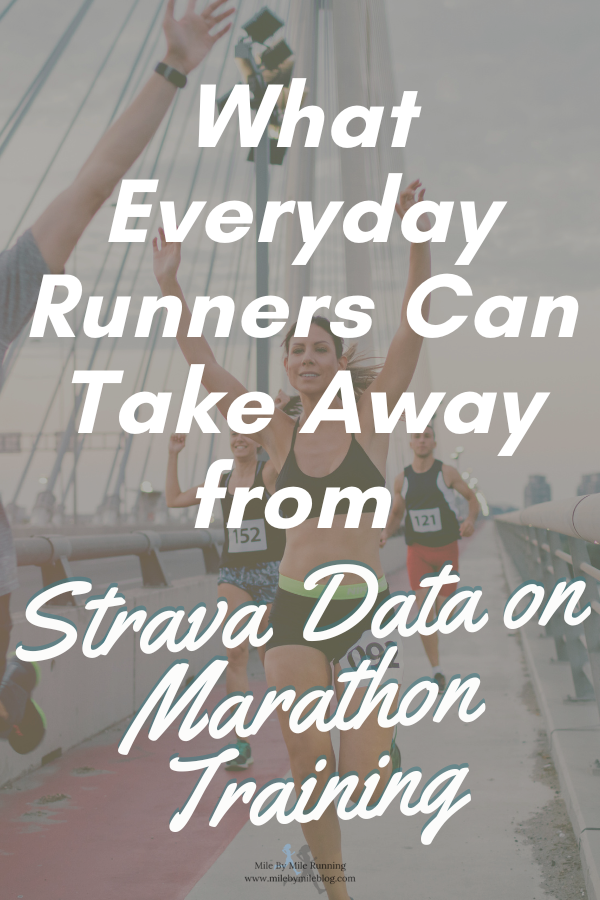
Are hard workouts really the key to a faster marathon? They likely have something to do with it, but a new study from Sports Medicine highlights that the fastest marathon runners had a large training volume with most of their time doing easy runs. So what does that mean for the everyday runner?

Are hard workouts really the key to a faster marathon? They likely have something to do with it, but a new study from Sports Medicine highlights that the fastest marathon runners had a large training volume with most of their time doing easy runs. So what does that mean for the everyday runner? This Strava data on marathon training gives us some insight into training intensity distributions (TID) across marathon runners and we can begin to unpack how this information can inform training approaches.

The Research Found from the Strava Data on Marathon Training

Most of the research we have on training intensity distribution and types of marathon workouts are from elite runners. While this can inform the training approaches of other runners, we know that there are differences between elite runners and everyday runners who may not have the time, support, or ability to train in the same way. This study looked at the 16 weeks leading up to 151,813 marathons by 119,452 runners.

Training intensity distributions were determined using a 3 zone approach, with zone 2 starting at 82.3% of critical speed and zone 3 starting at critical speed. (Critical Speed is the maximum speed that a runner can maintain for an extended period of time where speed can be sustained at a metabolic steady state effort.)

The data showed that faster runners (sub 2:30 marathoners) accumulated at least 3 times the amount of volume of the slower runners (sub 4:30 marathoners). What is particularly interesting is that the amount of training in zones 2 and 3 was essentially the same across all groups; the biggest difference in volume was seen in zone 1 (easy running).

You may also like: 3 Ways to Make Sure You Are Running Your Easy Runs Easy

Another noteworthy aspect of the faster runners’ training style was that the majority were using pyramidal training. This is basically where a majority of running happens in zone 1, a moderate amount in zone 2, and a small amount in zone 3.

Why Everyday Runners Should Include Plenty of Easy Running in Marathon Training

One takeaway from this study is that easy running is important. If you can increase your volume of running during marathon training, your safest bet is to add on more easy miles. You may also want to look at your TID and consider if it’s worth replacing some hard running with more easy or moderate running. We know that if you can safely increase your mileage without risking injury or burnout you may be able to improve marathon performance. Easy running is a great way to do that.

How to Use this TID Information from the Strava Data in Marathon Training

Going along with the focus on easy running is considering your training distribution. There is sometimes a fear of “grey zone” running but this is mostly a concern if you are running lots of miles at a moderate effort instead of doing easy runs. Look at the percentage of time you are spending in each zone. Is the majority of your mileage in zone 1? Are you doing some moderate miles and a few harder miles each week? 80% easy, 15% moderate, and 5% hard is an example of a way to breakdown pyramidal TID. If you use a 5 zone model (like most watches do) this will look different. To simplify this using a 5 zone model, you can think of your easy runs as zone 2, moderate as zone 3, and hard as zones 4 and 5.

Considerations for Everyday Runners

While this may sound good in theory, it’s not always as simple or practical to put into practice. There are few things to consider for us everyday runners. First, how much time do we have to train each week? This may limit the amount of running we can do, which would ultimately mean we would need to choose between reducing our hard workouts to fit in more easy runs or not adding as much easy running. We also might be running slower, which would mean each mile takes longer, and that adds up over the course of a week.

If we aren’t running as much in zone 1, then a pyramidal approach may not work as well. Some runners, especially beginners, need to focus in just getting in the miles without too much focus on workouts. Other runners may be limited by time constraints but still want to get in their speed workouts, and don’t have time for enough easy runs to get to that ratio. However, I think one takeaway is that if you DO have the time or desire to run more, try adding in additional easy miles and keep an 80/20 (or 80:15:5) split if that works for your training.

You may also like: Why You Should Follow Your Training Plan and Run Your Easy Runs Easy

So just like on Instagram, try not to worry too much about everyone else’s training. Remember that easy running is important, and can actually help you to get faster if it’s done correctly. And remember that all those fast workouts you see on Strava are only a small part of the equation.

You may also like:
How Many Weeks Does It Take to Train For a Marathon?
The Most Effective Recovery Tools for Runners
15 Tips for Successfully Running Your First Postpartum Half-Marathon

Have you read about the Strava data for marathon training?
Do you focus on easy runs when training for a marathon?
Runners Round up

Now it’s time for the Runners’ Roundup! Link up your running and fitness posts below! Join myself, Coach Debbie Runs, Confessions of a Mother Runner, and Runs with Pugs to post your favorite running tips, experiences, race and training recaps, workouts, gear, and coaching ideas.

You are invited to the Inlinkz link party!

Click here to enter

Coaching

Interested in learning more about the coaching services I offer? Learn more here!

Newsletter Sign up

Subscribe to the Mile by Mile Newsletter for Updates, Running Tips, and More!

* indicates required
Previous Post: « Master Winter Running with the Best Cold Weather Running Gear
Next Post: Create Tiny Habits to Take Your Running to the Next Level »

Reader Interactions

Comments

  1. Deborah Brooks says

    January 22, 2025 at 8:21 am

    When I really “trained” for my last half, really understanding and using more zone 1 runs was a huge benefit.

  2. Debbie says

    January 22, 2025 at 6:41 pm

    This is so interesting. When I was training seriously my running volume was pretty high (up to about 60 miles per week) but I think my zones were too high too. Ah well, everything is in zone one now. 🙂

  3. Catrina says

    January 28, 2025 at 11:25 pm

    Thanks for sharing that study! That’s really interesting.
    My coach did exactly this: most of the time, I was doing easy runs. I had two short speed sessions a week and a long run at the weekend. It worked very well!

Primary Sidebar

Welcome!

logo
Food Advertisements by

Training Plans and Running Guides

Training Plans
  • Bloglovin
  • Email
  • Facebook
  • Instagram
  • Pinterest
  • Twitter

Past Posts

Categories

VDOT Certified Coach

VDOT Certified Coach

RRCA Certified Coach

RRCA Certified Coach
logo
Food Advertisements by
logo
Food Advertisements by

© 2025 Mile By Mile Blog All rights reserved

Footer

Mile By Mile Running

Life Is What Happens When You're Busy Running Marathons

Lets Run!
  • Bloglovin
  • Email
  • Facebook
  • Instagram
  • Pinterest
  • Twitter
Alright, my last post about the Richmond Marathon Alright, my last post about the Richmond Marathon (maybe). This one is about lessons learned/areas for improvement.

1) Starting in the right corral- I knew I wanted to start a little slow but I think I started too far back and I ended up boxed in later in the race. 

2) Increasing fueling- I think I did the best I could on this day but now that I know more about what works/doesn’t work for me I think I can try to get my carbs/hr a little higher for next time

3) Self-doubt- On paper I knew my training showed I could run a certain time. My coach knew I could run a certain time. But deep down did I believe I could run that time? I’m not really sure.

4) My right piriformis- This little muscle has been giving me trouble FOREVER and it likes to rear its ugly head the most during races. I’m working with a PT but it’s hard to address the issue when I can go months without any problems and then at mile 15 of a marathon it starts acting up. So while this is certainly an area for improvement I am not really sure what I’ll be able to do to keep it from happening next time.

5) Ignore the data leading up to the race- During race week my sleep scores were horrible, my HRV tanked, and my watch told me I was “strained”. I might just stop wearing it during the taper next time.

What lessons have you learned during a marathon or big race?

@richmondmarathon #racerecap
It’s been 5 days since the Richmond Marathon and i It’s been 5 days since the Richmond Marathon and it feels like a lifetime ago! I am working on my full race recap which I will post on my website but I wanted to share some reflections on here. Today I want to focus on what went well. Every finish line is an accomplishment, and while every race can teach us something I think it’s always important to focus on the positive.

First off, Richmond was a great race with amazing crowd support! There were some hills (a few steeper than I expected) but nothing crazy.

Fueling went well- after my train wreck of a run a few weeks ago I had to adjust my fueling plan and took out the Tailwind High Carb and went back to regular Skratch instead. I tried to make up for the difference with gels but my overall carbs per hour was a little less than it had been when using the Tailwind. I think I got about 65 g/hour so I’d like to get that up a bit next time but I didn’t get nauseous and took gels up until the end of the race.

Shoes felt good- during that same training run I had some top of foot soreness from my laces. I changed my lacing technique and had no issues on race day. 

Mindset- I did a lot of work preparing for the race mentally and was able to use those strategies during the race. I focused on one mile at a time and shifted my goals when I knew my original goal was not going to happen. 

Pacing- Even though I didn’t run my goal pace I was able to run fairly consistently without drastically slowing down at the end. 

Recovery- I felt pretty good following the race and wasn’t even sore anymore by Tuesday. This was probably the least sore I’ve been after a marathon.

Strong training cycle- this year I feel like I’ve been clawing my way back to where I was a year ago after several illnesses last winter and spring. I had a great training cycle with @lauranorrisrunning and I know I’ve made more progress than my race time shows.

Marathons are a huge investment so I really tried to make the most of the experience!

@richmondmarathon #racerecap
Happy Medal Monday! I can’t believe the Richmond M Happy Medal Monday! I can’t believe the Richmond Marathon was only 2 days ago. I’m barely sore (probably because I was trained for a faster time than I ran) and am feeling good.

I included a list of my marathon times on the last slide here, which I posted in my stories yesterday. I got some messages about how others can relate to feeling like their times “reset” at a certain point- whether it was after an injury, having kids, or just time off from running.

I think we can get so caught up in PRs that it may take away from the overall progress made in the process of training. Sure, there are runners who come back from having kids and immediately set a new lifetime PR. But many of us will need to chip away at our times to get to where we want to be.

Focusing on progress and the gains made in a training cycle vs a specific race time can help to keep things in perspective!

Now, I’m trying to figure out spring racing plans. What’s everyone running this spring?

#medalmonday
What a day! This race (and really, this week) was What a day! This race (and really, this week) was a rollercoaster. I knew pretty early on that my legs and my lungs were not feeling my goal pace. Each time I sped up it felt really hard- way too hard to not even be at 10 miles yet. So I just focused on running the effort that my body would allow. I used all the mental strategies I had to get through each mile. Ultimately, I wanted to run faster than my marathon last November, which I did by almost 2 minutes, making this a postpartum PR. More importantly, I smiled almost the whole time.

After finishing we had to rush to get out of our hotel room and spent the whole afternoon driving home. Over the past 2 days I’ve spent almost 10 hours in the car.

More to come soon…just hoping to get home and get some rest soon!

#richmondmarathon
Follow on Instagram

Some of the links on my site are affiliate links. This means that I may receive a small compensation for clicks and/or purchases, but this will not cost you anything. Your support is greatly appreciated!


© Mile By Mile Blog, 2025. Unauthorized use and/or duplication of this material without express and written permission from this site’s author and/or owner is strictly prohibited. Excerpts and links may be used, provided that full and clear credit is given to Mile by Mile Blog with appropriate and specific direction to the original content.

Mile by Mile Running · Copyright © 2025

Copyright © 2025 · Carpe Diem on Genesis Framework · WordPress · Log in